Monday, September 24, 2012

Sim training

Flying the Q400 sim, after a lot of time sitting around and studying, i have started training on the level-D sim at the training facility. So far we have only been practicing the drills and procedure side of flying the aeroplane, and also circuit practice, landing at different flap settings, crosswinds and night time landings. Next up we have some more abnormal situations, bad weather circling approaches, lots of V1 cuts, engine fires - basically anything exciting that could potentially end in tears!

The sim!


Its been good to re learn everything and brush up on all the abnormal procedures again. Although we practice it every 3 months in the sim as line pilots, it's primarily 'checking' that we are proficient, rather than training us as I am getting now. Some people dread the sim and this sort of flying, and i admit it's not particularly 'fun', but i do find it beneficial overall.

I also went on some jumpseat rides to get familiar with the aeroplane. Very cool overall. Climbs like a rocket at 29 tonnes out of Sydney, and at a climb speed of 240kts indicated, we are still getting around 1700FPM in the climb. The Dash 200/300 was lucky to get 1000FPM at 170kts to give you some idea of how much more power this bus has. As turboprops go, you can't really match it for performance.

Anyway looking forward to finally flying the real thing!

This was taking a sticky beak in the 767 simulator! Might be old now, but i would still do anything to fly this aeroplane one day! Absolutely love it!


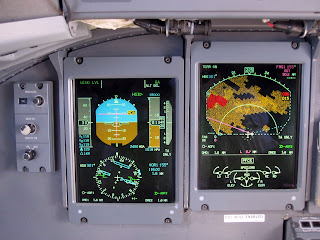
Captains Primary Flight Display (PFD) and multi function display (MFD) 


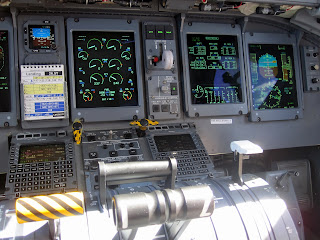
The Engine Display (ED) and the copilots instruments. You can see the electrical page on the co-pilot MFD which is normal procedure, other wise you have no other indications that the ground power is connected or batteries discharging when the plane is on the ground.


Looking back from the from the captains seat at the engine and wing! Looks bigger and better than the 300 ever did :)


Thanks for reading!

Thursday, August 30, 2012

Finished CBT

The PW150A of the Q400. Much bigger and looks better with 6 blades. The prop diameter is actually the same (well very similar) to the 200/300. Just 2000 extra horse power!


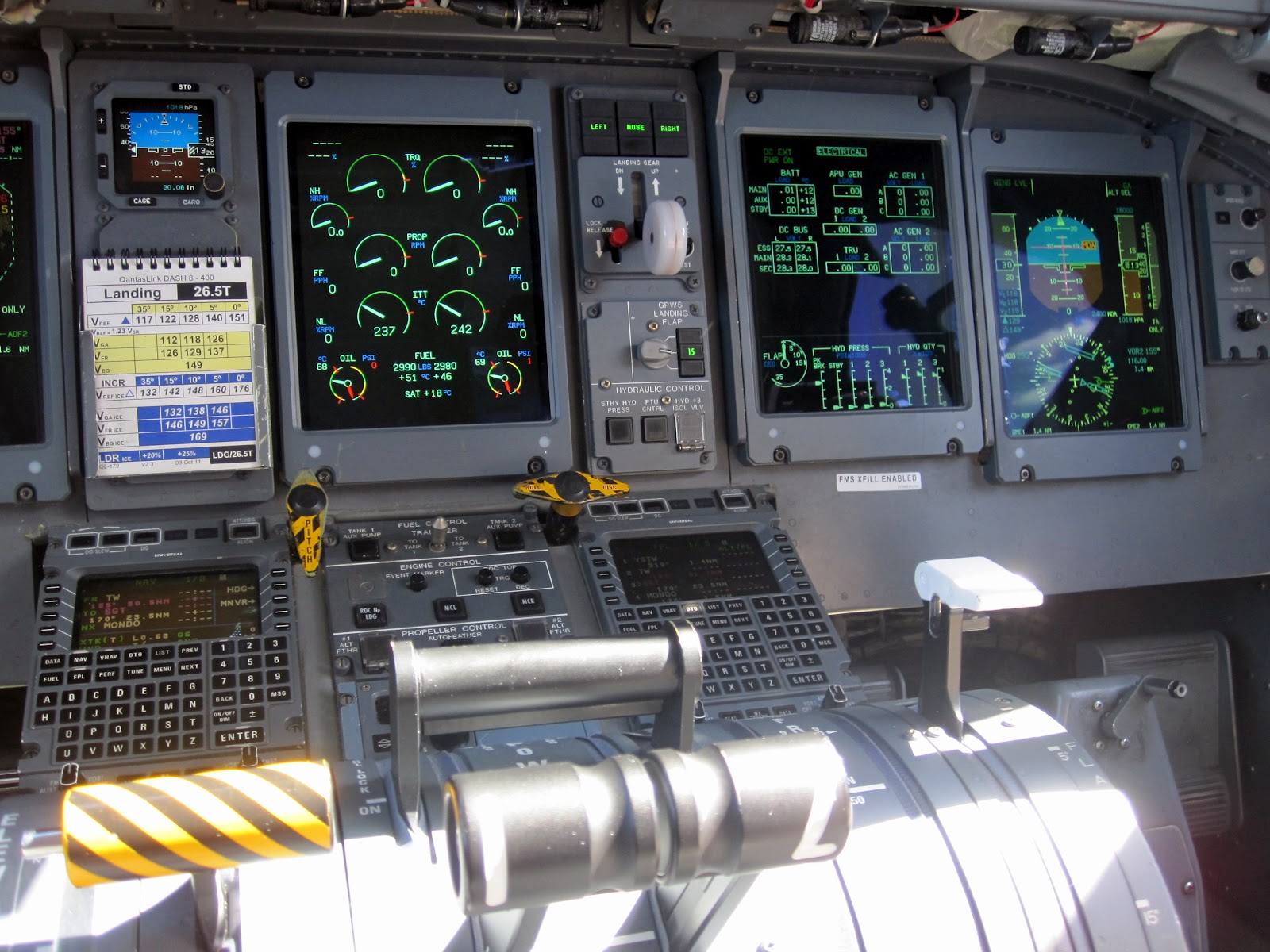
The flightdeck of the Q400. Nice LCD screens, less clutter and much nicer layout over all.


Sunday, August 26, 2012

CBT and the Q400

Well, what can i say. It's a much better plane, that's better where it wants to be, and simplified where it needs to be. Much bigger donks, FADEC, glass cockpit, more seats, more features. More fun perhaps?

Well, it's going well, half way through the ground school and work has already put in my roster some jumpseat rides to get familiar with the aircraft.

But, back to the computer based training. Roughly 1000 slides past, and another 1000 to go....


Wednesday, August 15, 2012

Last flight in the 200/300

Yup, it's finally here! I will be moving to the new Q400 as of Monday. I will be flying what is described as a small big plane, rather than a big small plane. I have enjoyed all the people i worked with on the 'sustaining' fleet as its called at work, but i'm looking forward to a new plane with "jet like speeds!"

The training is 2 weeks of CBT, a day of performance, emergency procedures and i think about 4 sim's both fixed base and full motion, before i do 20 sectors of line flying. At least i think it's 20.

Photos and more to come shortly.

Tomorrow will be the last flight, for the Armidale overnight. 

Thursday, August 9, 2012

Mount Hotham

Finally, i went to Mount Hotham! It was the final destination of our route network that i had not been to. So now when i start training on the Q400 in 2 weeks, i can tick the box.. 

Mount Hotham is 260nm south of Sydney. In relative terms, it is the same distance as Melbourne to Launceston. It is the highest elevation airport in Australia, at 4260ft. It's not particularly high comparatively to the rest of the world, or even Armidale, which is pretty much a daily event for me when i fly, at 3556ft.  

So i don't know what else to say except it was fun, close to the mountains and windy. Better yet, here are some photos!


The load sheet for the flight. It was done in a dash 8-200 series. Someone asked me to take a photo of it on a previous comment. The flight plan we used is below for the flight.


Snow!


Mountains approaching Hotham.


Backtracking runway 11.


Skipper hard at work as always when i'm around.


The airport itself.


I think they were planning on sending jets in here once upon a time, but as far as i know it never happened.


Friday, July 13, 2012

Before flying..

As requested by one of the comments and in line with the theme of the last post, here is a normal entrance and start of my working day, once beyond the gates of security, once i have bought a large take away flat white coffee, and once i'm past the entrance of the crew room.

Sign on to my work is 1 hour before the scheduled departure.

As i enter the crew room, the very first thing i do is head over to the flight planning computers and sign on through our 'crewnet' system. This will let operations know i am at work at the right time, and it will also let me print off my day duties, the captain i'm flying with, the planes i am using and also the cabin crew that i will be working with. It also has the scheduled departure times, arrival times, and any other relevant items specific to the duty. Such things include if it's an overnight and what hotel we are staying at, or if we have a jumpseat rider on the flight.

Usually the captain will be there already or arriving at a similar time. I am familiar with 99% of the captains that i fly with on the Dash8-200/300 fleet, so usually one of us will move over the computer that we are working at/signed on at, say "g'day" and work from there.

First things first, we need a few important documents to start it off. One of us will get the actual company flight plans, and usually print off a FOSO. A FOSO is a company issued document that tells us relevant things we need to know. I guess it's a company NOTAM. An example is changes with the gradients and runway distances at the aerodromes we fly too, and letting us know if we need amended RTOW charts or to continue using the same charts. (RTOW is the regulated take off weight, and are charts that tell us the maximum weight permitted for the runway, and if we can reduce the amount of take-off torque required if we are light, or require full power if we are heavy)


Flight plans!

The next thing we will do is open the flight planning software and enter our login details which will automatically bring up the flights, the plane registration we are flying and the flight planned routes. This will also generate a weather package for us which we can load and then print out. Usually one of us will read it on the computer and the other will read the printed version. We will compare the weather and any NOTAMS, and work out the associated winds aloft to figure out a fuel figures required for the flight we are doing.


Flight planning!

From here we will enter the fuel figure into the flight planning software, and it will auto generate the rest of the figure we need, such as variable reserve, fixed reserve. We will enter the standard holding fuel required for Sydney, we will also put in any weather holding if it is required, or if the weather is bad, put in the alternate and the fuel required for it.

From here will enter the fuel we need for the flight out and the return flight. The general fuel policy is to tanker fuel (ie carry the return trip fuel) and usually give ourselves a margin of around 20 - 30 minutes fat. This is for any mishaps or unexpected things happening such as extra taxiing time, extra holding, traffic when arriving at an outport, using the APU on the ground etc. This will then generate the weight of the aeroplane, the weight of the fuel, passenger loads, catering etc, and give us the estimated take-off weight. We will then goto the RTOW tables and figure out the maximum take-off available with the highest forecast temperature, on the most limiting runway with no wind, using a standing start (that means we apply full power the brakes on and release them once take-off power has been applied).

Once this figure has been entered, we can see whether the fuel load is good for the flight, or maybe we need to sharpen the pencil and take less if it is say a hot day and we are fully loaded, or maybe we can take more fuel if it's the overnight sector just in case we get hit with extra holding delays in the morning. We will usually have a discussion and why or what we think, which is usually stamped with a mark of approval of both saying "yup, happy with that." All done.. We submit the flight plans, we submit the fuel figures to operations so they can organise the fuel truck, and print a copy for ourselves. A quick staple and usually the first officer is delegated to carry the all important paperwork.

At this point, we are about 15 - 20 minutes in, and have 40 minutes to departure. Company policy is we arrive at the aeroplane 30 minutes beforehand, and the cabin crew 25. Boarding commences 15 - 20 before our departure time. So i usually get 'dressed' (put on the epaulettes, wings and tie) get my flight bag, and wait till we both walk to the plane.

Our crew room is located near the gates that we use to park the planes, and usually walking to the gate is out of a separate door and walking on the tarmac and using dedicated walkways to get to our aeroplane, unlike other airlines which usually walk through the terminal to their specific gate. One of the weird things with the airline i fly for is that our crew room and operations is located in terminal 3 in Sydney, yet we depart all our flights (except Canberra flights) through terminal 2.

From here we arrive, and both do a walk around. If it's hot, we will put on the APU for bleed air, and sometimes ground power if we don't have a power cart. I get in and usually the plane is already set up for where we are going, but sometimes it isn't. we have a before start drill for the first officer (7 items) while the captain has around 50 :)

I check the circuit breakers, i reset the clock, i set the navaids, and radios, check my flight instruments, power levers flight idle, and condition levers at fuel off, and last but not least write a take off data card, get the ATIS and fill in the paperwork for the flight....

"Call ready for boarding.."


Monday, July 9, 2012

Its been a while!

Hi! I haven't been neglecting this blog; more just not 100% sure what to write about! But i thought of something that may be interesting. I thought i might try write a day in the life of me. For lack of much else to write about at the moment, i will try dumb it down and write a basic story of what i would do on say a standard flight, taking off to the south for a departure to head north.


The SID's are pretty straight forward out of Sydney. On a typical day, say on a flight to Port Macquarie, taking off to the south on 16L Sydney, we will be assigned the KAMBA 4 departure or the SYDNEY 3 departure. For this flight we are using the KAMBA 4 departure.


Still at the bay, Terminal 2, with the engines started -


After start drills commenced once the engines are brought out of feather to flight idle.. bleed air - on.. APU - off.. AC voltage - checked.. standby hydraulic pumps - on.. autofeather - select.. auxiliary fuel pumps - on.. flap selector to 5.. confirm the transponder is alt, auto.. de-ice pressure is 18psi.


After start checklist completed, we are ready for taxi..


Taxiing from terminal two in Sydney, you usually get a standard taxi route to the south, depending which bay you are on. For the controllers, we get issued to hold short of taxiway golf, or runway 25. Approaching runway 07/25, the clearance is usually to cross runway 07/25, taxi to holding point Bravo 10, runway 16L.


This is confirmed by the captain, and once clear of the crossing runway, we start with the taxi checklist.. confirm flight instruments are erect with no error or caution flags - checked.. assigned altitude - 3000 with alt select.. cabin - prepared..


We are ready.


At Sydney we exit taxiway Charlie with a left turn onto taxiway Bravo10 and call Sydney tower, 124.7 to let them know we are ready.


Cleared for take off... approaching the active runway he will call clear left and i will clear right to make sure there are no aeroplanes that the controller has forgotten about on the approach path. I put on the landing lights and strobes and the captain calls for the line up drills...


Transponder is still alt auto.. pitot heat - on.. weather radar - on.. control locks off and flight controls tested and free.. bleed air is min and off..


"Taxi checklist completed."


Since this is my take-off, the captain calls "your controls.."


"My controls, call me V1 at 107 knots, set power..."


"70knots........ V1... rotate"


"Gear up."


"500ft, turn left to track 080"...


"Confirmed.."


At 600ft we do the acceleration drills.. as pilot flying I call "Flaps 0, bleeds on, set climb power..."
(The acceleration drills refer to a safe altitude where we are clear of obstacles, can clean up the aeroplane and accelerate to our climb speed and set the climb power. If we are to have an engine failure, this is the altitude we would accelerate at our best clean climb speed, get the flaps up and set maximum continuous power.)


Sydney tower then transfers us. "Contact departures, G'day.."


From this stage we are usually cleared to 5000ft, as inbound traffic is maintaining 6000ft. Once the new altitude is set, i would call for autopilot modes which i want to fly the aeroplane in. 


"Can i have flight director modes LNAV, indicated 170.. 12 miles on the TCAS and the after take-off checklist."


After take off checklist "landing gear - up no lights.. flaps - zero.. pressurisation - bleed air on, max and the rate 200FPM...."


Autopilot engaged.


7DME Sydney, left turn, track direct KAMBA.


Departures would then normally clear us to climb to flightlevel 180, once we are clear of the inbound traffic. Passing 10,000ft we do the transition drills which is setting QNH on the altimeter to 1013, standby hydraulic pumps to norm (which is off...), auxiliary fuel pumps off, and lights off.


"Checklist - Altimeters - 1013.. pressurisation - bleed air on max and rate 300FPM," 


"After take-off checklist complete - Speakers?"


At this stage our headsets come off, and we put the speakers on in the flightdeck. We get an estimate for arrival to the destination and i hand over control to make a cabin announcement...


"Ladies and gentlemen, from the flightdeck, good morning to you and welcome abroad..........."


Well, thats a standard day to about flightlevel 120 and about 30nm from Sydney.