Tuesday, March 10, 2015

NEW BLOG

Hey guys.

Just wanted to say thanks to all the support i have had since 2009 when i started this. I will not be posting on this website anymore, however i am still making videos and still blogging.

You can follow my new page at

flyingwithmike.net


Once again thanks so much, i know i haven't contributed much recently but with a new project i'm all excited for it again. If i repeat the stories and photos i'm also sorry ;)

Cheers

Mike

Sunday, November 9, 2014

Flying a jet

Now that i'm flying the 737, there are some very big differences from flying turboprops.

For those that think jumping into a jet is easy, and that flying a prop is the same, if not harder (as most guys on props think) then you are wrong, and yet, also right.

First things first - Multi crew operation and all that jazz is a big learning curve for anyone who has come from a general aviation background, single pilot, or even multi crew from an operator with a mix of procedures that were slapped together. I was luck that i had virtually the same procedures at the last job that carried over to the new one. In fact - virtually all the calls were the same, so it was more about learning to fly the plane, than the airlines procedures AND learning to fly the plane.

However there are some big ticket items.. The technology in the jet, FMC's, RNP-AR procedures, captains and the HUD, 168 people on board, 5 cabin crew, longer to turn the plane around, bigger amounts of fuel.. the list will go on and on and on. All this changes and i found i can fly a sector with 5 crew and realise i didn't even see the ones who were working down the back. There is also so much paperwork involved in getting an aeroplane off the ground.. its amazing and to the airlines credit a lot of it is becoming electronic and less wasteful.

I think back to flying a 404 titan, and we hold more fuel in weight in each wing, than that plane was max take off weight with 13 pax. (A380 holds virutally a 737 in the tailplane in fuel - but thats another story).

People think the jets fly themselves, but it's not the case. There is so much hands on, and yes the computers do a fantastic and safer job in the cruise and on climb. Much safer and more effective than i can hand fly, and has other safety features to stop us making mistakes. But if we enter all the information wrong, or tell it to do the wrong then - Then yep - it does the WRONG thing.

The plane can autoland as well.. That's great however i have seen it struggle to even hold a centreline (usually based on wind), i have been witness to the FLARE not arming and i have also seen a go around due to the critical zone of the ILS structure not being protected. Yes - a great tool in fog and low visibility, but still requires pilots input when it goes wrong and to make sure it is doing the right thing.

One of the biggest things i found with the jet was the momentum. You cannot slow down the 737 easily at all.. It loves going fast, and the only way to slow it down is with a lot of drag (landing gear) or to plan a level segment. The VNAV on descent usually does a good job, especially if there is a headwind, but on a strong tailwind, it has no chance of holding profile, and requires either speed brake, or early planning to get down at a shallower rate, to intercept the path. This can always be thrown out by ATC who wants us faster, or slower, depending on traffic - In a turbo prop speed was very easy to control and maintain.. The path stayed the same as well mostly, at 3 degrees. I remember never having trouble to get a speed or to control the descent. I guess those props act like big speed brakes.

On approach, in windshear conditions, the props were amazing.. Instant airflow over the wings if you needed it, and on the Q400, a bootload of power was available if you required it. The Q400 got bumped around a lot for sure, and the speed was all over the shop, but it was so easy to get that power and speed to recover if it decayed too much. On the jet however, once you lose momentum, it needs a lot of power and a lot of recovery to make up that speed decay and it is standard procedure to conduct a go-around if these conditions occur and a windshear warning is triggered.

I don't miss the 5 sectors days of flying the props, and 20 minute turn arounds. Sometimes it was more fun, and knowing it was only an hour flight home was great, but give me one sector days, or two sectors any time of the week. May get a big boring in the cruise on long sectors, but its better than dealing with minimum speed and delays into big airports every second sector - and then minimum rest to do it all again the next day. How many hours of our lives, and tonnes of jet fuel have we wasted in holding patterns due to inefficient airports?

I guess finally i would like to say, that there is not much chance sometimes to divert if necessary. Often we fly and land with around 3.5 - 4 tonnes of fuel (which is quite a bit for the 737 - Margin rate of around 2.4 tonne an hour). To do a missed approach and come back around we use about a tonne of fuel. We need to land with 30 minutes as a minimum (about 1.2 tonne), so we would be committed to landing at that airport, no matter the weather. For us to divert means, we do a missed approach and then divert straight away without trying the destination airport again. I remember in the Q400 Sydney airport closing, and we were able to hold for 50 minutes before diverting to Canberra and still land with our reserves well intact.

Anyway, i probably digressed from the original topic a bit, it was more of my thoughts this morning. Was good to write something again too!


Filmed in 1080p on a Gopro 4.. Enjoy

Thursday, October 30, 2014

Youtube

Thought i would share a video i posted online to YouTube about a year ago, when i was flying the Q400. I hope you enjoy it.


Friday, August 15, 2014

A few photos from flying the line recently. Almost finished training, but still a few hurdles to go. For all those that have watched landings into Wellington on bad days, i now know what it's like to fly it.

Windy landings - Wellington


Saturday, June 7, 2014

Current times

A collection of some new photos. Almost 737-800 endorsed... thanks for reading..


A

Sunday, April 6, 2014


Some recent photos for you to enjoy. It will probably be the last post i make about the Dash 8. To those who still read it, stay tuned for the next chapter!

Might have to start blogging more again soon..

A new job, a new plane and a new place.. It's all happening very soon! Very excited, and yes, jets are on the agenda.

CBT to begin in 2 weeks!...

Endorsement in 3!


Tuesday, November 19, 2013

Hindsight Post

HI!!!! To all those that still read my blog - I am totally sorry for the complete lack of posts in the past year. I get a bit paranoid about posting things these days. As some of you would be aware i have been very into my videos and GoPro youtube channel - which replaced my blogging. I absolutely love filming and the editing, but alas i have also taken these down for a period of time due to people posting them to Facebook.

I'm writing this post to just express some thoughts. I am still an FO on the Q400. Had i stayed on the classic 200/300 i would have been a captain 6 months ago. Now i am stuck in the right seat for probably at least the next year. That was a big decision i knew i was making, and i guess the reality didn't really hit home until now. But i do love the Q400 and i guess overall i am happier flying a big turboprop - which literally does haul ass.

I am also writing because i have friend who have recently started their first airline job and are telling me what they are going through with learning the drills, the recalls, the procedures - all while being trashed in the sim at back of the clock sessions which take a toll on any person. It is not an easy process to learn multi-crew flying, and it's probably the hardest thing i have learnt in flying to date.

But i write this in hindsight - right now my job is easy, even complacent at times. I fly from the right seat confidently in knowing what my job is, knowing what it involves and knowing that i am in fact good at it. I know what my responsibilities are, i know what i can and cannot do, and i know that on a given day i will learn something, make a mistake or even teach someone something. I know i will push the boundaries at times - flying fast to an approach and learning how to rectify it, or rather, i KNOW i can rectify it and make it still work to company SOP's. I know i can adhere to SOP's without thinking about the SOP's, i know i can grease a landing on the tarmac without particular care anymore. I know i can do a simulator session and be told that i know what i'm doing and that as a support pilot or pilot flying that i'm doing my job correctly.

All these things are fantastic and i am satisfied i have learned my role. There is still more to learn no doubt, and there is a never ending facet of knowledge i can put myself through. The job is dynamic no matter what repetition the job actually is. Weather changes, the airport runways changes, the registration of the plane changes, the crew changes, the controllers change... It is a never ending endeavour to learn. I love this aspect and i cherish it.

I recently turned down an actual start date on a 737 jet. It makes me wonder on why i did this? I don't even have a correct answer to a lot of people, but for some reason i know it was the correct one. Potentially this command will come and that experience will be worth its weight in gold. I will learn even more, i will experience even more, and the glass ceiling will be lifted once again.

I write this in hindsight, some thoughts which have been going through my head of recent times. I love flying, and its the only thing i have ever wanted to do. I write this post as something of a retrospect that i'm still doing what i love. I'm still chasing the bigger dreams of a jet job, and i'm still chasing the dreams of sitting in the left seat. But to be good at any other role, you need to learn your role first - and that quest of knowledge really is never ending. I guess talking to my friend and his first airline role - being scared of his first flight.. not being confident of knowing his procedures... of lacking the skills and the captain might think ill of him... the knowledge to KNOW, that you are the one for the job and that no matter how hard you find it - you will always learn and you will always progress.

Was not my intention to have a big motivational speech.. Anyway, i will try blog some more and regularly in the future.

Cheers, Mike

Tuesday, June 4, 2013

You get some amazing shots flying. I guess that's the second biggest perk of the job! With number one being i get paid to do what i love. There aren't to many jobs around where people bring cameras to your place of work and take photos of you working. I guess i share their passion, except i get to take the photos from inside the flightdeck. So this is my second favorite part of my job, being able to take photos of the amazing things i see.. unfortunately a lot of scenes just aren't easily captured by a camera. Sunrise and sunset in particular. Maybe when i fly a bigger plane with longer sectors i will bring my big SLR to work and try capture some more. Until, i have only these.

Once again i thank everyone who still follows this blog. I know i don't post anywhere near what i used to, but i have to be careful in the day and age of social media and what is acceptable at my work and what isn't.


Until the next post, enjoy sunrise from FL190.

Monday, April 1, 2013

Well.. i haven't blogged in a while.. I didn't really know what to write.. but here are some pictures in the mean time!

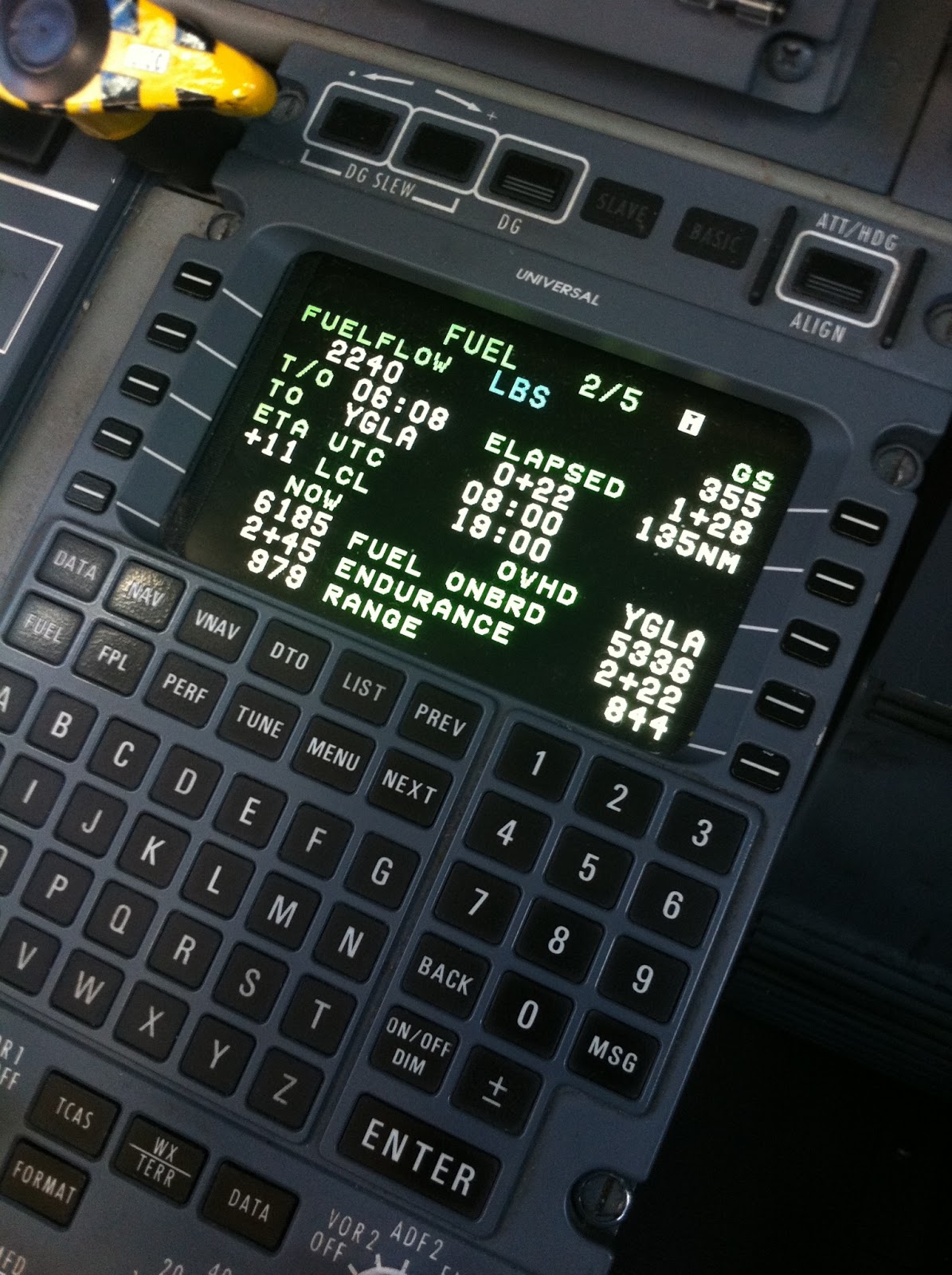
For those who read this still (if there are any) i recently flew a Sydney to Gladstone routing, which is a long way, but had solid loads which was good to see.. Here are some photos from that.

For those other readers, Gladstone is 50nm south of Rockhampton in North Queensland. I didn't really realise how far away it is, and really is too long for a turboprop, even one with 'jet like speeds'. But i'm sure those who need to get to GLA without the need to transfer through Brisbane, would be a big time saver.


Northbound to GLA, Flightlevel 240


Various FMS shots on our 610nm epic journey!


Finally, landed at GLA.. Token prop shot from the foward door


Night time shot from cruising level FL250

Tuesday, December 4, 2012

A few photos from doing various flights, all the way from Adelaide, up to Brisbane..


Monday, October 15, 2012

Flying the Q400

First flight was from Melbourne to Adelaide, for a 4 sector day. After the Adelaide we do a few Port Lincoln shuttles. Port Lincoln is a small town 200km due west of Adelaide, famous for its tuna fishing and great white sharks.

I have done a lot of flying out of Melbourne and it was no real surprise there, so I was reasonably comfortable with my surroundings. However, a new plane, a training environment, a long and then short, fast sector to Port Lincoln.. anyway, what an introduction to the plane than with a 360nm leg between two major Australian cities and a smaller outport, both of which i haven't flown into.

Training captain decided first leg and last leg should be mine, afterall what better way to learn than be thrown into the deep end. Short taxi out to the runway 27 threshold of Melbourne.

"Line-up drills"...

I turn on the radar, get the external lights on, turn on the pitot heats, get the control locks off and see full free movement of the spoilers, ailerons and elevator and set the bleed air to min flow, and but leave the bleed air on.

"Cleared for take-off, heading 263"

V1.. Rotate..

We pitch up to approximately 9 degrees nose up.. All i have to say is 'wow' at this point. The plane rapidly increases speed to about 185 knots, climbing at around 3000FPM. (To put this into comparison, the 200/300 used to climb out at 170kts at about 1000FPM)

Passing 1400ft, i call for the flaps to zero, bleeds on and set climb power. We accelerate to 210 knots and contact departures.

We are cleared straight away to our cruising level of flight level 240, and get tracking direct to Bordertown, our first waypoint of our flightplan.

At this stage, being not overly heavy at 26.5 tonnes, we are able to accelerate to 240kts climb, and still achieve 2000FPM climb. Through transition altitude we turn off the exterior lights, turn off the tank aux pumps, and set climb power of 850RPM.

We make a cabin announcement to passengers which is an indication to the cabin crew that we are no longer sterile flight deck, and is also an indication that we are hungry and to please bring up our lunches! :) Leveling off at FL240 we set cruise power. We are pushing into a 60kt headwind, and have a TAS of 360Kts, but achieve only a groundspeed of 300. Still, 300 groundspeed is one of the best i ever saw in the Dash-8-200/300.

So far so good with the training! It's been fun so far, the training captain is very relaxed and we are having discussions about certain aspects of the plane while we eat our meals. He tells me the easiest way to prepare for descent in the Q400 is to remember: Bugs, Brief, VNAV, format. (I personally like to brief the STAR and approach first then set the up the bugs, but each to their own)

Anyway, this makes sense and works quite well.. We bug for a flap 15 landing, on the speed tape and set the GPWS flap selector to 15. (If this was say set to flap 35 then we would get a GPWS warning of "too low - flaps" which would necessitate a go around) Since it is going to be a visual approach via the 23 ILS into Adelaide, we set the MDA bug to 1000ft as that is the acceleration altitude if we had to do a go around.

We then brief the STAR and ILS arrival into Adelaide (we do the ILS for practice in this case for my benefit) and we prepare a VNAV into the FMS for the our decent planning. I set the format (this is a key that allows us to switch our MFD (multi function display) to "blue needles," or in other words, raw data VOR format and we can set up the runway direction of 222 degrees for the ILS approach.

All ready for our decent! We receive clearance to FL140 and begine descent. Passing through FL200 we ask the cabin crew to prepare the cabin for landing.

Further descent clearance is to 7000 feet. Passing through FL110 is our transition drill where we turn on the lights, put on the tank aux pumps and set the QNH for the landing airport. At this stage we are racing a 737 inbound and due to the fact we don't accept track shortening (as we are doing the ILS for practice) we are given a few short vectors to the north.

"Track direct track to Modbury, descent 3000 cleared ILS 23 approach"

Modbury is the NDB about 12nm north of the 23 ILS and is also the initial approach fix. We pass over it at 210Kts, which is the company speed for the initial approach fix. Power levers to flight idle, we prepare to configure the aeroplane. At around 7nm from the airport we configure flap 5, and shortly after gear down. Continue to decelerate past 172 knots and call for "flap 15, landing checklist"

Well.. a bit of wind, and few bumps, but otherwise a nice day.. First landing in the new plane was a greaser! Good start with good landing mojo! Awesome.. I must say though, the power levers and my hands were reasonably sweaty and i apologised to the skipper when he took over control passing 50 kts on the landing rollout..

All in all a great flight, and i'm loving the new plane. Thanks for reading

Monday, September 24, 2012

Sim training

Flying the Q400 sim, after a lot of time sitting around and studying, i have started training on the level-D sim at the training facility. So far we have only been practicing the drills and procedure side of flying the aeroplane, and also circuit practice, landing at different flap settings, crosswinds and night time landings. Next up we have some more abnormal situations, bad weather circling approaches, lots of V1 cuts, engine fires - basically anything exciting that could potentially end in tears!

The sim!


Its been good to re learn everything and brush up on all the abnormal procedures again. Although we practice it every 3 months in the sim as line pilots, it's primarily 'checking' that we are proficient, rather than training us as I am getting now. Some people dread the sim and this sort of flying, and i admit it's not particularly 'fun', but i do find it beneficial overall.

I also went on some jumpseat rides to get familiar with the aeroplane. Very cool overall. Climbs like a rocket at 29 tonnes out of Sydney, and at a climb speed of 240kts indicated, we are still getting around 1700FPM in the climb. The Dash 200/300 was lucky to get 1000FPM at 170kts to give you some idea of how much more power this bus has. As turboprops go, you can't really match it for performance.

Anyway looking forward to finally flying the real thing!

This was taking a sticky beak in the 767 simulator! Might be old now, but i would still do anything to fly this aeroplane one day! Absolutely love it!


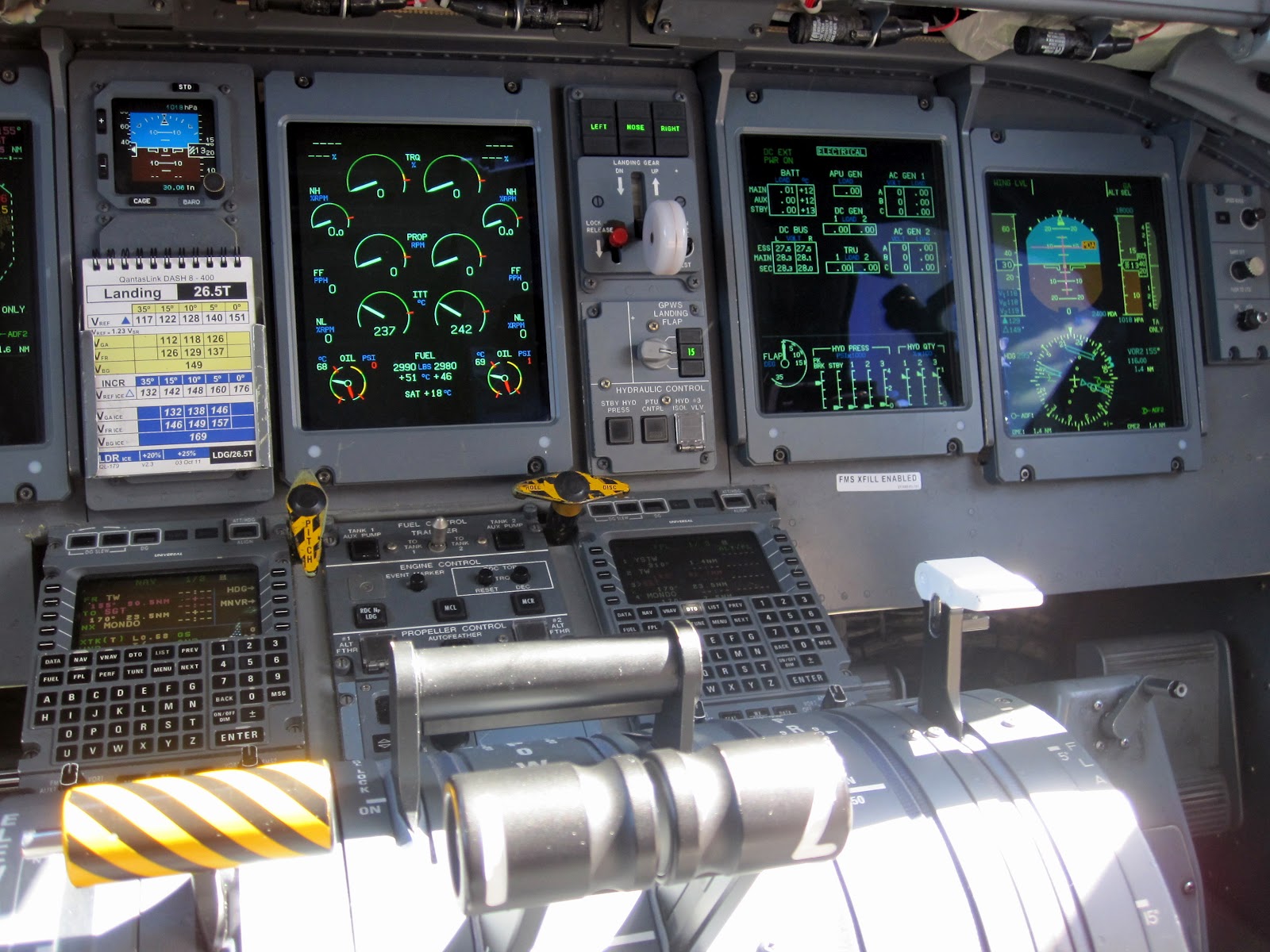
Captains Primary Flight Display (PFD) and multi function display (MFD) 


The Engine Display (ED) and the copilots instruments. You can see the electrical page on the co-pilot MFD which is normal procedure, other wise you have no other indications that the ground power is connected or batteries discharging when the plane is on the ground.


Looking back from the from the captains seat at the engine and wing! Looks bigger and better than the 300 ever did :)


Thanks for reading!